
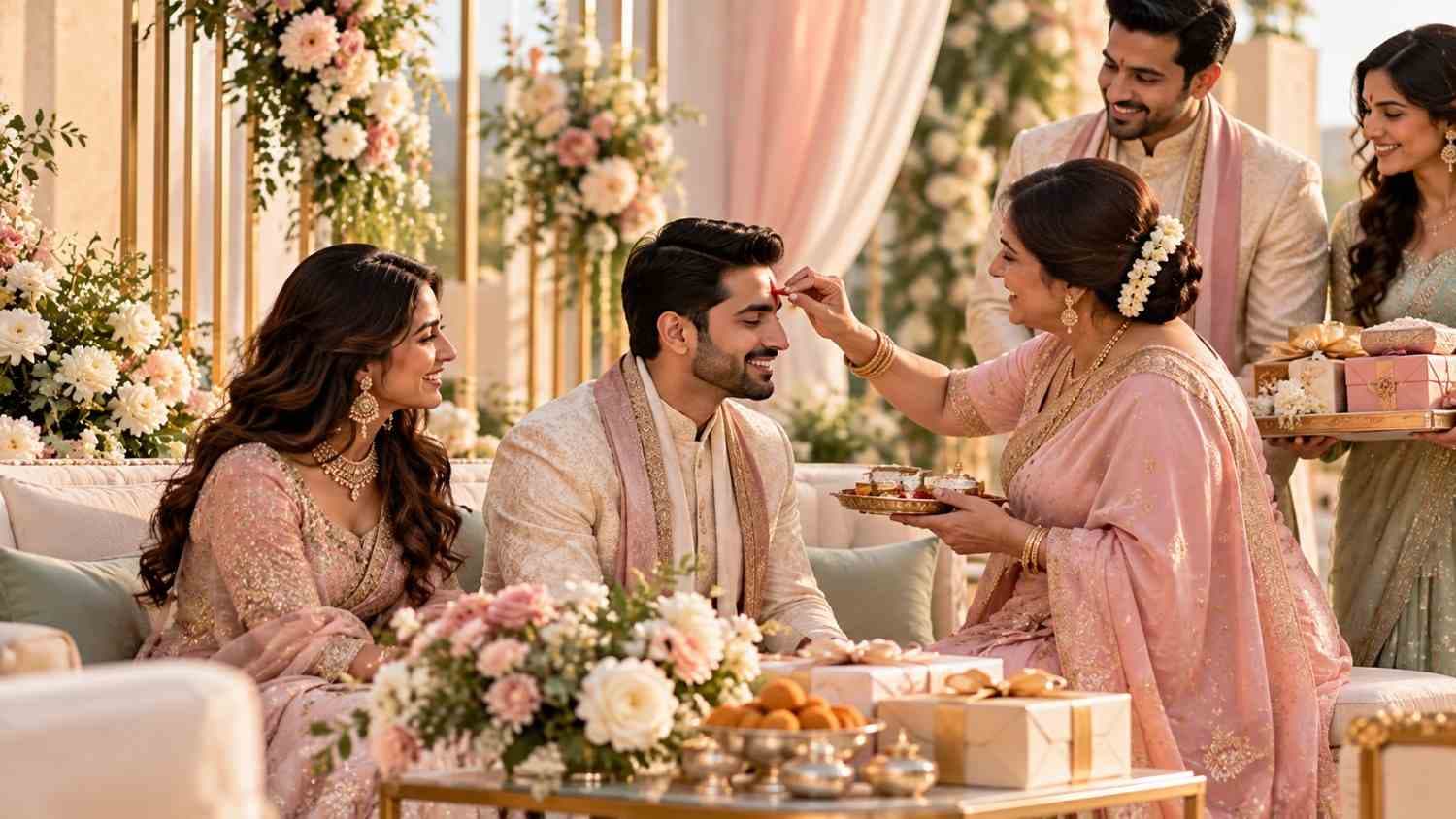
Long before the mandap, the baraat, or the sangeet stage lights, an Indian wedding journey typically begins with two smaller, more intimate rituals: Roka and Tilak. Often confused with each other or treated as interchangeable, these ceremonies actually mark distinct milestones, formally announcing a couple's decision to marry and setting the wedding planning process into motion.
Understanding what each ceremony represents, and how they differ, helps families plan them with the right significance rather than treating them as a single generic "engagement" event.
What Is the Roka Ceremony?
Roka, derived from the Hindi word meaning "to stop" or "to reserve," is traditionally the first formal step in an Indian wedding process. It marks the point at which both families officially agree to the match and announce that the couple is no longer available for other marriage proposals.
Key elements of a Roka ceremony
- A small, typically family-only gathering, often held at the bride's or groom's home
- Exchange of gifts, sweets and sometimes rings between both families
- A priest or elder may perform a brief puja or blessing, though this varies by family tradition
- Both families formally acknowledge and bless the union, marking the couple's engagement in principle
What Roka signifies
Roka is primarily a family-to-family commitment rather than an elaborate ceremonial event. It signals that both sides have agreed to the marriage and are now ready to begin discussing wedding dates, logistics and further ceremonies.
What Is the Tilak Ceremony?
Tilak is a more formal, ritual-heavy ceremony, typically held after the Roka, in which the bride's family visits the groom's home to formally welcome him into the family and mark the beginning of wedding preparations.
Key elements of a Tilak ceremony
- The bride's father or a senior male family member applies a tilak (a mark, usually of vermilion, sandalwood paste or turmeric) on the groom's forehead
- Gifts, sweets, dry fruits and sometimes cash or jewellery are presented to the groom by the bride's family
- A formal aarti (ritual with a lit lamp) is often performed to bless the groom
- The event typically concludes with a shared meal between both families
What Tilak signifies
Tilak represents formal acceptance of the groom by the bride's family and is considered an important ritual acknowledgment of the upcoming union, particularly in North Indian Hindu wedding traditions. Unlike Roka, which can be relatively simple, Tilak often carries more ceremonial weight and religious significance.
Key Differences Between Roka and Tilak
Here's a quick comparison to understand how these two ceremonies differ:
- Purpose - Roka: Formal family agreement to the match | Tilak: Formal welcome and blessing of the groom
- Typical timing - Roka: First ritual, often before Tilak | Tilak: Usually follows Roka, closer to detailed wedding planning
- Who hosts - Roka: Either family, often smaller and more private | Tilak: Typically hosted at the groom's home by the bride's family
- Religious element - Roka: Often minimal or optional | Tilak: Usually includes a priest-led ritual and aarti
- Scale - Roka: Small, family-only gathering | Tilak: Slightly more formal, sometimes with extended family present
While these distinctions hold in many North Indian traditions, it is worth noting that regional and community customs vary considerably, and some families combine both rituals into a single event depending on personal or regional preference.
Regional Variations in These Rituals
North Indian Traditions
Roka and Tilak are generally observed as distinct ceremonies, often held weeks or months apart, allowing both families time between the initial agreement and the more formal groom-welcoming ritual.
Other Regional Practices
In many South Indian, Bengali, Marathi and other regional traditions, similar concepts exist under different names and formats, such as Nischayathartham in Tamil culture or Ashirwad in Bengali tradition, each carrying comparable significance but distinct rituals specific to that community.
Modern Adaptations
Increasingly, some families choose to combine Roka and Tilak into a single event, particularly when families live in different cities and want to minimise the number of separate gatherings required before the main wedding.
Why These Ceremonies Still Matter in Modern Weddings
Even as Indian weddings have grown more elaborate and production-focused, Roka and Tilak retain their core purpose: formally marking a couple's transition from an accepted match to an officially committed engagement, witnessed and blessed by both families. For many families, these smaller, intimate rituals hold as much emotional significance as the larger wedding events that follow, precisely because of their close-knit, personal nature.
Planning Considerations for Roka and Tilak
Guest List
Both ceremonies are traditionally smaller than the main wedding, typically limited to immediate and close extended family, though some modern families choose to expand the guest list for a more celebratory event.
Decor and Styling
While traditionally understated, many couples now incorporate light decor elements, floral backdrops, simple stage setups and coordinated outfit colours, to make these events more photograph-friendly without losing their intimate character.
Timing Relative to the Main Wedding
Roka and Tilak are typically held several months to a year before the main wedding, though this varies significantly by family preference and how far in advance the wedding date itself is finalised.
Gift and Ritual Coordination
Since both ceremonies involve specific gift exchanges and ritual elements, coordinating with family elders on regional customs and expectations in advance helps avoid confusion or oversight on the day itself.
Conclusion
Roka and Tilak represent the quieter, more intimate beginning of an Indian wedding journey, standing in contrast to the scale and spectacle of later events like the sangeet or main ceremony. Understanding their distinct meanings, Roka as the formal family agreement and Tilak as the ceremonial welcoming of the groom, helps families plan these early rituals with the significance they deserve, setting a meaningful tone for the wedding celebrations that follow.
At PS Decor, wedding planning support extends to early rituals like Roka and Tilak, helping families coordinate decor, logistics and styling for these meaningful first steps of the wedding journey.
Frequently Asked Questions
- Are Roka and Tilak the same as an engagement ceremony?
They serve a similar overall purpose to a Western-style engagement, but Roka and Tilak are distinct rituals within Hindu wedding tradition, each with its own specific significance and customs. - Which ceremony happens first, Roka or Tilak?
Roka typically happens first, marking the initial family agreement, followed by Tilak, which formally welcomes the groom into the bride's family circle. - Can Roka and Tilak be combined into one event?
Yes, many modern families choose to combine both ceremonies into a single event, particularly for logistical convenience when families live in different cities. - Is a priest required for Roka and Tilak ceremonies?
Not always for Roka, which is often a simpler family gathering, but Tilak typically includes a priest-led ritual and aarti as part of its more formal structure. - How far in advance of the wedding are these ceremonies usually held?
This varies by family, but Roka and Tilak are commonly held several months to a year before the main wedding, depending on when the date itself is finalised.